Chasing the Wind 1

 Apple Podcasts
 Spotify
 Castro
 RSS Feed
 Podchaser
 iHeartRadio
 TuneIn
 Podcast Addict
 Welcome to Gospel Rant, and our new series, Chasing the Wind!
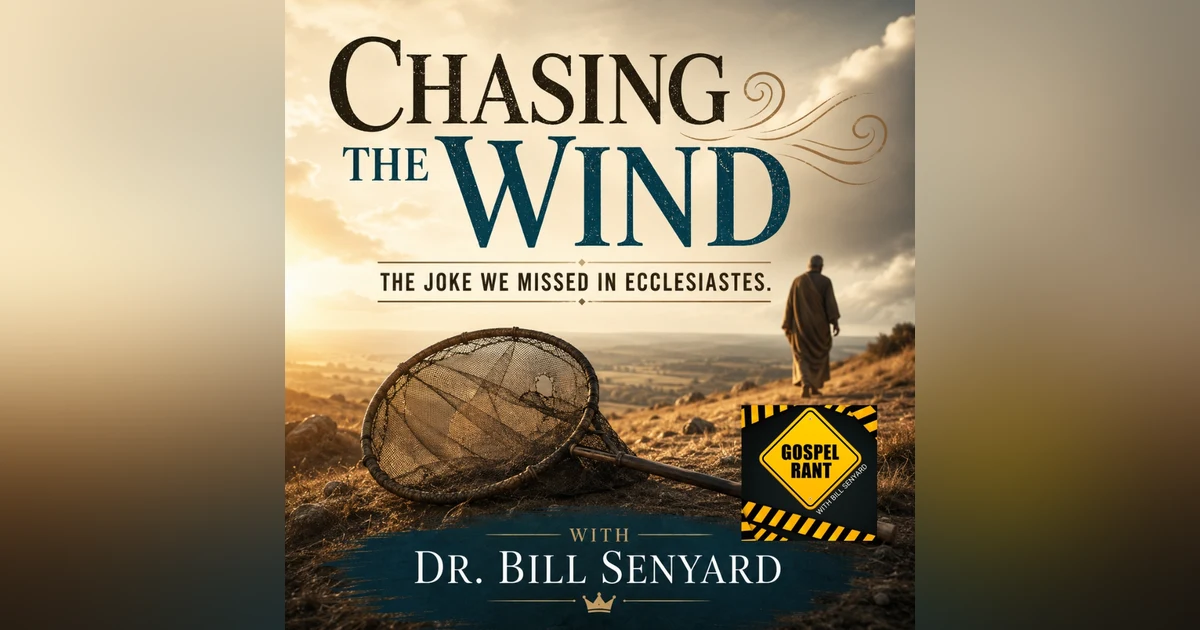
CHASING THE WIND
Episode 1: What If Ecclesiastes Is a Joke?
The Joke We Missed in Ecclesiastes
The Most Depressing Man in the Bible
“Meaningless! Meaningless!”
says the Teacher.
“Utterly meaningless!
Everything is meaningless.”
Welcome to Ecclesiastes. Have a nice day.
Seriously, what are we supposed to do with this guy?
He looks at work: meaningless.
Pleasure? Meaningless.
Wealth? Meaningless.
Wisdom? Eventually you're dead.
Righteous people suffer. Wicked people prosper. You can't figure out what God is doing. And whatever you accomplish, somebody else eventually gets it.
This is the wisdom book?
What if we've been missing something?
What if Ecclesiastes isn't simply telling us that life is absurd?
What if it's showing us the absurdity of trying to understand life without the one thing necessary to understand it?
What if Ecclesiastes... is satire?
We will see what you think.
And now, it’s your turn…
👉 Like
👉 Share
👉 Comment
👉 Subscribe
Your interaction helps this message reach more people!
We’d love your feedback: Bill@gospel-app.com
Thanks in advance—and enjoy the series!
Take heart, child of God.
Support The Show: https://www.gospelrant.com/
Discover more Christian podcasts at lifeaudio.com and inquire about advertising opportunities at lifeaudio.com/contact-us.
Speaker 1: So welcome to Gospel Rants podcasts and Doctor Bilson of YouTube beginning to do series called Tastings the Win and episode number one is this, what if Ecclesiastes is actually a bit of a joke, and it's the joke we miss You'll see what I mean. No disrespect to Ecclesiastics, but I think this clears up so much of the problematic nature of the book and I think extremely extremely helpful. Yeah, so I want to introduce you to the most depressing man in the entire Bible. We're going to begin with cohal It, the subject of the book, primarily right, or I'm just going to call him q cohll it meaningless, meaningless, says cohal It, the teacher. Ugly meaningless, Everything is meaningless. Right, Welcome to Ecclesiastes. You know, I have a nice day. Seriously, what do we say supposed to do with this guy? He looks at work meaningless, pleasure meaningless, wealth, meaningless, wisdom. Eventually you're dead. Righteous people suffer, wicked people prosper. You can't figure out what God is doing, and whatever you accomplish, somebody else eventually gets it. This is a wisdom book. What if We've been missing something. What if Ecclesiastes isn't simply telling us that life is absurd? What if it's showing us the absurdity of trying to understand life without the one thing necessary to understand it. What if Ecclesiastes is satirical, a satire so chasing the wind the joke we missed in Ecclesiastes Again, Welcome to Gospel Rant podcast and doctor Bill sent your YouTube channel. I'm the host, Doctor Bill Sinard. We're free wherever you get good podcasts, of course on YouTube as well, so please subscribe. One of the fastest ways you can help grow is by leaving your comments below. Thank you sincerely for that. Also, thanks for making Gospel Ran podcast one of the top ten percent podcasts in the world and top sixty Christian podcast in the state of Colorado. Thank you for listening every week. We hope that it helps to regularly hear about God's love that loves the unlovable, the unlovely, the unworthy, and the unlikely, and that's all of us on any given day if we were just a little bit honest, I want to get right into it. After this brief word from our sponsors. I'll be right back. So, look, have we been quoting the wrong guy. It's the fundamental literary problem of Ecclesiastes. The Bible says there's nothing new under the sun? Well who said it? Readers should understand the Ecclesiastes contains a voice within a frame. There's Cohela Q, the teacher gatherer, but there's also another voice framing his material, And in the end that voice addresses my son. Voice two has collected and presented Q's wisdom for the benefit of the disciple, and then gives the disciple a warning about what he's heard. The disciple and the son are the same person. So I imagine picking up a novel containing the speeches of a fascinating character. You would not automatically assume that everything the character says represents the author's opinion. But that's often exactly how we've read Ecclesiastes. Maybe Coohela It isn't a narrator we're supposed to trust unquestioningly. Maybe we're supposed to listen to him carefully and increasingly think something's wrong here. Fun right, So MEETQ the wisdom influencer, and Q actually introduces himself I have increased in wisdom more than anyone who has ruled over Jerusalem before me, and I have seen all things that are done under the sun. So what it surprised you that this guy Q has seen everything, possesses extraordinary wisdom, and yet conspicuously doesn't ground his investigation in the Torah or Yahweh God. Today, this religious leader Q would have an enormous podcast, you know, three million subscribers, the Cohalt experience and his pitch. I've studied success, I've studied money, I've studied sex, I've studied pleasure, I've studied work, religion, death, and I'm going to tell you what I've discovered. Well, that's worth something, right, And what has the wisest guy in the room discovered? It's all havel, the Hebrew word for smoke, vapor, something without substance or anything lasting foolishness. Well that's funny, but increasingly it's tragically funny. So I'm going to suggest that Q is the tragic wisdom clown. Not an idiot, no, not evil, absolutely not not somebody we dismiss. A brilliant man, well meaning man who still spends his valuable time chasing the wind chasing things that aren't worthy of his brilliance. That's what satire does, right, good satire. If you're looking to write satire, first look to the real world. What are current social and political trends? What issues do you see in your hometown, your country, in the news on social media. The best satire speaks to the current times by reflecting either what people are currently saying or doing, or what they aren't saying or doing. I mean, you can see YouTube in that and TikTok and right Instagram. You want to make people think about the world as it is and how it could be if things changed. You know, aim for one specific issue or a few overlapping issues. Pick something meaningful to you, something that you truly care about, and so that passion actually is heard and seen in your writings. Then use these techniques to help build your satirical audience and satire. One a humor. Make people laugh because that engages their attention. I mean, even if they're cringing as they're laughing. Make them laugh and then make them think irony. Use irony to show the difference between how they think about something and the reality by demonstrating as much as you can what people can or won't say hyperbole a grossly exaggerated scenario to help ridicule the world as it is, or an issue as it is, drawing attention to flaws and magnifying them, or exploiting the consequences that those flaws, if they're remain to be unchecked. Exaggerated understatement can draw attention to flaws by what's missing, helping people again see the consequences of flaws unchecked Allegory make the story able to be read literally in one way, but then there's a deeper meaning when read another way. Careful, however, to ensure your satires read as satire, otherwise people are going to think you're crazy. I think movies like Doctor Strange, Love If You're My Age, or This Is Spinal Tap, or TV's Mighty Python, books like Jonathan Swift's Some Modest Proposal, Animal Farm George, Orwell the Far Side cartoons Gary Larson. I mean ancient satires, which are arguably contemporaries of Ecclesiastes. Aristophanes around four hundred and forty eight BCE wrote sharp theatrical old comedies like The Clouds, the Birds, the Frogs that relentlessly mocked prominent Athenian figures, philosophers like Socrates, and the war mongering politicians. Satire often pretends it affirms something while exaggerating it enough that eventually you realize, well, I'm not supposed to agree with this. This is supposed to be a warning. So an Ecclesiastes, exaggeration, irony, juxtaposition, and a parent agreement become weapons used against the thing being portrayed. And I'm going to suggest, mocked. What is Ecclesiastes target. I'll get to that q Coheleat repeatedly calls his project chasing after the Wind. Now think about that image. Picture some of the world's most distinguished intellectuals standing in a field, robes blowing degrees on the wall, years of study, brilliant minds. Every one of them is holding a butterfly net and they're running around trying to catch the wind. That's funny. That's Monty Python ESQ, that's Gary Larson ESK. Unless you're holding a net too. The joke and Ecclesiastes ultimately may be about us, because no judgment, we're cue. We still believe if we knew enough, if I knew enough, if I earn enough, save enough, optimize enough, exercise enough, eat enough vegetables, understand myself enough, get enough therapy, get read enough books, listen to enough podcasts, really only need one, and eventually you're going to crack the code and beneath it all is the ancient human promise, I can figure out how to make all of this work, all life work, relationships, identity, sexuality, meaning, purpose, glory, legacy. So imagine a recurring Q cycle. I think Groundhog Day, the movie. You and I are independently trying to figure everything out, but then we discover our limitations. Then we fall into recognizable despair. Then we get up and try harder, wash, rense, and repeat. But the unnamed editor's alternative, right, the voice at the end of the book, says this, discover your limitation and return to God's revelation and trust. Yahweh. That's not c that's this editor other voice who's speaking to his son. That's the theological engine of the entire podcast. Maybe Havel vapor missed nothingness isn't God's verdict on life. Maybe Havel is what life inevitably begins to look like when I insist on being the person who has to make out of it. Does that makes sense. First clue track me here. There's something strange. The man claiming extraordinary wisdom, Q keeps telling us that he can't make sense of things right, Yet one of the great Biblical words associated with genuine wisdom be nah. Discernment is virtually absent from his great investigation. It would be like doing construction without a saw or measurement device or nails. For those who are convinced that Q is Solomon, here's an interesting data point against that. Solomon specifically asked God for benah discernment he was smart. Biblical wisdom requires it. Yet Ecclesiastes barely uses the term, and only once in passing What if that's the joke? We'll say more about discernment and wisdom. But of course everything looks meaningless if you lack the ability to discern its meaning. That's the point, satire. What is the meaning of life? Tragedy, happiness, love, comfort, loss, purpose, sexuality? Injustices? Look, maybe Q isn't stupid. I don't think he is. Maybe he's much more dangerous than that. Maybe he's brilliant without discernment, And maybe that's why he sounds so much like me, like us. The noun bena is never mentioned in Ecclesiastes, though fifteen times it's mentioned in Proverbs, the Real Wisdom Book. The verb form is only mentioned once, compared to thirty four times in Proverbs, where ironically Q complains that under the sun, even the discerning don't get cash, they don't get wealthy. Ecclesiastes nine to eleven quote, I have seen something else under the sun. The race is not to the swift, or battle to the strong, nor does food come to the wise. Or here it is wealth to the brilliant. The word is be not to the discerning, or favor to the learned, but time and chance happen to them all. Well, that's not very discerning, right. Well, over the next seventeen sessions, we are going to follow this strange, wonderful, well meaning, brilliant man Q. We're going to let him try everything work, money, pleasure, wisdom, religion, sects, success, justice, and even goodness, and we're going to watch what happens. Because perhaps Ecclesiastics isn't God's depressing little book but the meaningless of life. Perhaps it's God's wonderfully subversive warning about what happens when extraordinarily intelligent human beings try to find the meaning of life without first finding the author of it, without faith, without this biblical trust right in a New Testament sense, without the Holy Spirit. So welcome to chasing the wind. It is possible, even likely, that we've discovered something slightly scandalous in a biblical book that I think we've been misreading for years. Okay, what's next? I will let you know after this brief word from our sponsors. So have a new book coming out, Good Enough Christian. It's actually out. It's a sequel to Good Enough Parent And here's the back cover. Why so many Christians feel stuck and how to experience more? Are you a Christian who believes the Gospel but just doesn't feel loved by God? You're not alone. If you've ever felt spiritually stuck. If you've quietly wondered why the abundant life Jesus promised me you out of your reach. If you sat in church hoping to feel loved and yet you left unchanged. If you haven't felt that inner stirring for a long while, maybe you've already left church for a while. You know lots of reasons. The pattern is unmistakable, sincere Christians who love Jesus but feel stalled in their faith, not rebellious, not apathetic, wondering if they've somehow become a disappointment to God. With warmth, honesty, biblical depth, and disarming humor, the book invites readers into a shame free exploration of why so many believers struggle to experience the love of Christ, not just believe it intellectually. You'll discover why feeling spiritually underwhelmed is more common than you think. Hidden obstacles that dull are experience of God's love. The role of the Holy Spirit this is so important. I call him the missing member of the Trinity. The role of the Holy Spirit in making Christ's love real, not theoretical. How your brain, background and church culture shape your faith experience a gentler, more grace saturated path forward. Right. Look, this is not a call to try harder, It's an invitation to experience more. What does the love of Jesus actually feel like? Then? This book was written for you. Welcome to good enough Christian So check it out and get copies for your church, your pastor, your Bible studies, your book club. They will thank you good closing, Thanks for listening. To my series Taking the Wind. Next time, we're going to begin to meet Lady Wisdom. She couldn't be any more different from you, and that tells you a lot. See you next time, take our Child of God
